



Arduino UNO Web-ingeschakelde Servo Besturing met PHPoC WiFi Shield
Onderdelen en Benodigdheden
| Arduino UNO | × | 1 |
| PHPoC WiFi Shield voor Arduino | × | 1 |
| Seeed Servo Motor | × | 1 |
| Jumper Wires | × | 1 |
Over Dit Project
Inleiding
Als je beginner bent, raad ik aan te lezen over Arduino - Servo Motor en Arduino - WiFi.
Om Arduino met het internet te verbinden, hebben we een internet shield nodig zoals een Ethernet shield, WiFi shield, PHPoC shield of PHPoC WiFi shield.
De uitstekende eigenschap van de PHPoC shield is dat hij niet alleen internetverbinding biedt zoals Ethernet en WiFi shields, maar ook een ingebouwde webserver die toelaat om Arduino vanuit een webbrowser te besturen en te monitoren. Het ondersteunt ook WebSocket, waardoor we Arduino in realtime kunnen besturen en monitoren zonder een webpagina te herladen.
De PHPoC Shield heeft enkele ingebouwde webapplicaties. Raadpleeg deze link voor meer details.
In dit project heb ik de UI (User Interface) van de Web Remote Control/Slide webapplicatie aangepast, en Arduino-code geschreven om de servomotor hoek te laten draaien volgens de hoek die ontvangen wordt vanuit de webbrowser.
Aansluiting
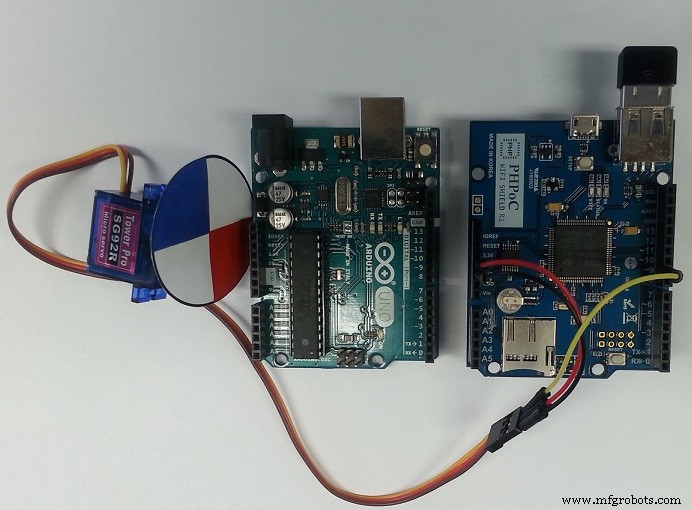
- Stapel de PHPoC shield op de Arduino
- Verbind pin GND, VCC en signaal van de servomotor met GND, 5V en pin 9 van de Arduino, respectievelijk.
Dataflow
Webbrowser → PHPoC Shield → Arduino
De webapp berekent de hoek op basis van touch- of muisevents, stuurt het naar de PHPoC shield via WebSocket. Bij ontvangst van deze data geeft de PHPoC shield het door aan de Arduino. De Arduino draait de servomotor naar de ontvangen hoek.
Wat We Moeten Doen
- WiFi-informatie instellen voor PHPoC shield (SSID en wachtwoord)
- Nieuwe UI uploaden naar PHPoC shield
- Arduino-code schrijven
WiFi-informatie Instellen voor PHPoC Shield
Zie deze instructie: https://www.phpoc.com/support/manual/p4s-347_user_manual/contents.php?id=network_first_setup
Nieuwe UI Uploaden naar PHPoC Shield
- Download PHPoC broncode remote_rotate.php (in code sectie)
- Upload het naar PHPoC shield met PHPoC debugger volgens deze instructie
Arduino Code Schrijven
- Installeer bibliotheek voor Arduino in Arduino IDE (zie de instructie) en herstart Arduino IDE.
- In Arduino IDE, ga naar Bestands -> Voorbeelden -> Phpoc -> WebRemoteSlide en Bestands -> Voorbeelden -> Servo -> sweep.
- Combineer de twee voorbeelden tot één, dan hebben we de code om de servomotor via een webpagina te besturen (zie de broncode in de code sectie).
Testen
- Klik op de seriële knop in Arduino IDE om het IP-adres te zien
- Open webbrowser, typ https://vervang_ip_adres/remote_rotate.php
- Klik op connect-knop en test het
De Beste Arduino Starter Kit voor Beginners
Als je op zoek bent naar een Arduino-kit, zie The Best Arduino Kit for Beginners.
Functiereferenties
- Arduino - Servo Bibliotheek
- Servo.attach()
- Servo.write()
- Servo.writeMicroseconds()
- Servo.read()
- Servo.attached()
- Servo.detach()
- Serial.begin()
- Serial.println()
- delay()
- for lus
- while lus
- if else
- loop()
- setup()
- String.toInt()
Code
- remote_rotate.php
- Arduino code
remote_rotate.php PHP
<!DOCTYPE html> <html> <head> <title>PHPoC Shield - Web Remote Control for Arduino</title> <meta name="viewport" content="width=device-width, initial-scale=0.7, maximum-scale=0.7"> <style> body { text-align: center; font-size: 15pt; } h1 { font-weight: bold; font-size: 25pt; } h2 { font-weight: bold; font-size: 15pt; } button { font-weight: bold; font-size: 15pt; } </style> <script> var canvas_width = 400, canvas_height = 400; var plate_radius = 160; var click_state = 0; var last_plate_angle = 0; var plate_angle = 0, last_angle = 0; var ws; function init() { var canvas = document.getElementById("remote"); canvas.addEventListener("touchstart", mouse_down); canvas.addEventListener("touchend", mouse_up); canvas.addEventListener("touchmove", mouse_move); canvas.addEventListener("mousedown", mouse_down); canvas.addEventListener("mouseup", mouse_up); canvas.addEventListener("mousemove", mouse_move); var ctx = canvas.getContext("2d"); ctx.translate(canvas_width / 2, canvas_height / 2); rotate_plate(0); } function connect_onclick() { if(ws == null) { var ws_host_addr = "<?echo _SERVER(\"HTTP_HOST\")?>"; var debug = document.getElementById("debug"); if((navigator.platform.indexOf("Win") != -1) && (ws_host_addr.charAt(0) == "[")) { ws_host_addr = ws_host_addr.replace(/[\[\]]/g, ''); ws_host_addr = ws_host_addr.replace(/:/g, "-"); ws_host_addr += ".ipv6-literal.net"; } ws = new WebSocket("ws://" + ws_host_addr + "/remote_slide", "text.phpoc"); document.getElementById("ws_state").innerHTML = "CONNECTING"; ws.onopen = ws_onopen; ws.onclose = ws_onclose; ws.onmessage = ws_onmessage; } else ws.close(); } function ws_onopen() { document.getElementById("ws_state").innerHTML = "<font color='blue'>CONNECTED</font>"; document.getElementById("bt_connect").innerHTML = "Disconnect"; } function ws_onclose() { document.getElementById("ws_state").innerHTML = "<font color='gray'>CLOSED</font>"; document.getElementById("bt_connect").innerHTML = "Connect"; ws.onopen = null; ws.onclose = null; ws.onmessage = null; ws = null; } function ws_onmessage(e_msg) { e_msg = e_msg || window.event; alert("msg : " + e_msg.data); } function rotate_plate(angle) { var canvas = document.getElementById("remote"); var ctx = canvas.getContext("2d"); ctx.clearRect(-canvas_width / 2, -canvas_height / 2, canvas_width, canvas_height); ctx.rotate(angle / 180 * Math.PI); ctx.strokeStyle="red"; ctx.fillStyle="red"; ctx.beginPath(); ctx.arc(0, 0, plate_radius, Math.PI, Math.PI * 1.5); ctx.lineTo(0, 0); ctx.lineTo(-plate_radius, 0); ctx.fill(); ctx.stroke(); ctx.strokeStyle="blue"; ctx.fillStyle="blue"; ctx.beginPath(); ctx.arc(0, 0, plate_radius, 0, Math.PI / 2); ctx.lineTo(0, 0); ctx.lineTo(plate_radius, 0); ctx.fill(); ctx.stroke(); ctx.strokeStyle="black"; ctx.arc(0, 0, plate_radius, 0, Math.PI * 2); ctx.stroke(); ctx.rotate(-angle / 180 * Math.PI); } function mouse_down() { if(ws == null) return; var dist_min, dist_max, dist; event.preventDefault(); if(event.offsetX) { x = event.offsetX - canvas_width / 2; y = canvas_height / 2 - event.offsetY; dist_min = 40; dist_max = plate_radius; } else if(event.layerX) { x = event.layerX - canvas_width / 2; y = canvas_height / 2 - event.layerY; dist_min = 40; dist_max = canvas_width / 2; } else { x = (Math.round(event.touches[0].pageX - event.touches[0].target.offsetLeft)) - canvas_width / 2; y = canvas_height / 2 - (Math.round(event.touches[0].pageY - event.touches[0].target.offsetTop)); dist_min = 40; dist_max = canvas_width / 2; } var dist = Math.round(Math.sqrt(x * x + y * y)); if((dist > dist_min) && (dist < dist_max)) { click_state = 1; last_angle = Math.round(Math.atan2(y, x) / Math.PI * 180); } } function mouse_up() { if(ws == null) return; event.preventDefault(); click_state = 0; } function mouse_move() { if(ws == null) return; var dist_min, dist_max, angle, dist; event.preventDefault(); if(!click_state) return; if(event.offsetX) { x = event.offsetX - canvas_width / 2; y = canvas_height / 2 - event.offsetY; dist_min = 40; dist_max = plate_radius; } else if(event.layerX) { x = event.layerX - canvas_width / 2; y = canvas_height / 2 - event.layerY; dist_min = 40; dist_max = canvas_width / 2; } else { x = (Math.round(event.touches[0].pageX - event.touches[0].target.offsetLeft)) - canvas_width / 2; y = canvas_height / 2 - (Math.round(event.touches[0].pageY - event.touches[0].target.offsetTop)); dist_min = 40; dist_max = canvas_width / 2; } angle = Math.round(Math.atan2(y, x) / Math.PI * 180); dist = Math.round(Math.sqrt(x * x + y * y)); if((dist < dist_min) || (dist > dist_max)) { click_state = 0; return; } if((Math.abs(angle) > 90) && (angle * last_angle < 0)) { if(last_angle > 0) last_angle = -180; else last_angle = 180; } plate_angle += (angle - last_angle); last_angle = angle; if(plate_angle > 180) plate_angle = 180; if(plate_angle < 0) plate_angle = 0; rotate_plate(-plate_angle); if(plate_angle != last_plate_angle) { if(ws && ws.readyState) { ws.send("C" + plate_angle.toString() + "\r\n"); last_plate_angle = plate_angle; debug = document.getElementById("debug"); debug.innerHTML = plate_angle; } } } window.onload = init; </script> </head> <body> <p> <h1>Web Remote Control / Rotate</h1> </p> <canvas id="remote" width="400" height="400"></canvas> <h2> <p> WebSocket : <span id="ws_state">null</span><br> Hoek : <span id="debug">0</span> </p> <button id="bt_connect" type="button" onclick="connect_onclick();">Connect</button> </h2> </body> </html>Arduino code Arduino
/* arduino web server - remote control (slide switch) */
#include "SPI.h"
#include "Phpoc.h"
#include <Servo.h>
PhpocServer server(80);
Servo myservo; // create servo object to control a servo
char slideName;
int slideValue;

void setup() {
  Serial.begin(9600);
  while(!Serial) ;
  Phpoc.begin(PF_LOG_SPI | PF_LOG_NET);
  server.beginWebSocket("remote_slide");
  Serial.print("WebSocket server address : ");
  Serial.println(Phpoc.localIP());
  myservo.attach(9); // attaches the servo on pin 9 to the servo object
  myservo.write(1);
}

void loop() {
  // wait for a new client:
  PhpocClient client = server.available();
  if (client) {
    String slideStr = client.readLine();
    if(slideStr) {
      slideValue = slideStr.substring(1).toInt();
      myservo.write(slideValue);
      Serial.print("Angle: ");
      Serial.println(slideValue);
    }
  }
}Productieproces
- Web-gestuurd DMX-verlichtingssysteem – Arduino Master Controller
- Bluetooth-gecontroleerde Arduino Spybot bouwen
- Slimme spaarpot bouwen: Muntenacceptor besturen met Arduino Nano
- Slimme Huishoudapparaatbesturing via Web & Mobiele Apps
- Arduino Power Control Center: N-FET, P-FET, Relais & RTC Kit
- Een LED bedienen via Bluetooth met Arduino – Eenvoudige DIY Handleiding
- DIY Arduino Luchtbevochtiger Controller met Relais – Veilige Hoogspanningsopstelling
- Twee Stappenmotors Sturen met Arduino Nano & Joystick – Simpele Tutorial
- Arduino UNO & WiFi Shield: Realtime Temperatuurweergave op het Web via Serieel
- Beveilig uw Arduino met Webpatroonontgrendeling – Eenvoudige Setup & Remote Control
- Draadloze Arduino Programmeer Shield met HC-05 Bluetooth – Geen USB Nodig