



Realtime afstandsmeting met Arduino Sonar & Processing visualisatie
Onderdelen en benodigdheden
| Arduino UNO | 1 |
| SG90 Micro-servomotor | 1 |
| Ultrasone sensor HC-SR04 (algemeen) | 1 |
| Draadjes (algemeen) | 1 |
| Solderloos breadboard (vol formaat) | 1 |
Benodigde tools en machines
- Lijmpistool (algemeen)
- Solderstation, SolderPro 150
Apps en online diensten
- Arduino IDE
- Processing (The Processing Foundation)
Over dit project
Hallo iedereen, ik werd aangeraden een obstakelvermijdende auto te bouwen, maar dat leek me te gewoon en onpraktisch. Daarom bedacht ik een sonar te maken met behulp van het concept van de servo en HC-SR04-sensor van zo'n auto.
Ik had geen TFT LCD-scherm om de sonar-uitvoer weer te geven. Toen dacht ik aan de Processing IDE, waarmee je de uitvoer op je pc kunt tonen met een mooie resolutie! Omdat ik nieuw was met Processing, oefende ik eerst met de p5 web editor en ging daarna over naar de Processing IDE met enkele libraries om de sonar-data uit te lezen en weer te geven.
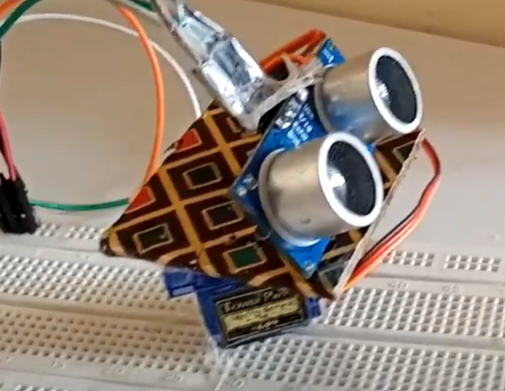
Ik heb de ultrasone sensor met een lijmpistool op de servomotor geplakt, zodat de sensor mee draait met de servo en een bereik van 180 graden afdekt. De uitvoer (of een object gedetecteerd wordt of niet) wordt in Processing getoond, en ik schreef extra code die de afstand en hoek nauwkeurig weergeeft.
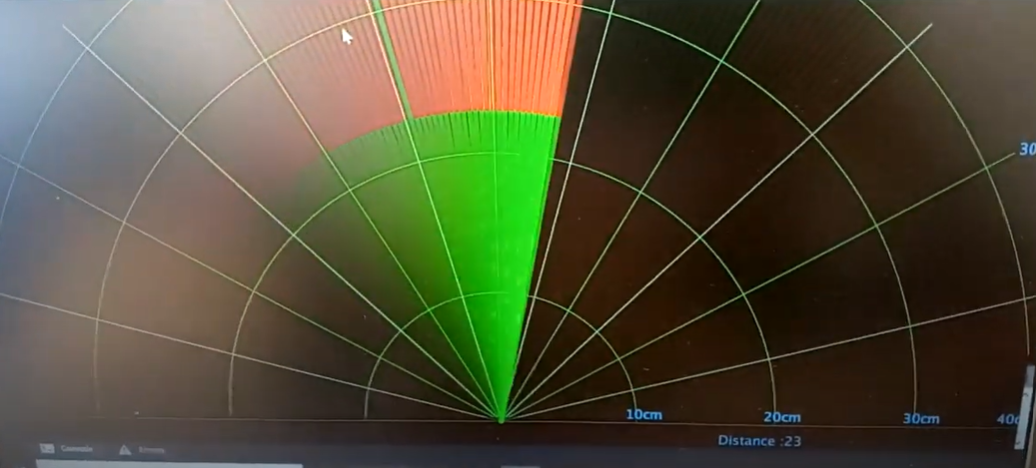
Vrienden, ik heb ook gedeeld hoe de uitvoer in Processing eruitziet; je kunt de afbeelding als referentie gebruiken voor je project.
Nu we weten hoe de opbouw en uitvoer eruitzien, is het enige wat overblijft de video van de resultaten. Kijk de video tot het einde om de uitvoer goed te begrijpen.
Code
Sonar code voor Arduino IDE (C/C++)
#include <Servo.h>
const int trigPin = 12;
const int echoPin = 11;
long duration;
int distance;
Servo s1;

void setup() {
  Serial.begin(9600);
  pinMode(trigPin, OUTPUT);
  pinMode(echoPin, INPUT);
  s1.attach(9);
}

void loop() {
  for(int i = 0; i < 180; i++) {
    s1.write(i);
    delay(30);
    distance = calDist();
    Serial.print(i);
    Serial.print(",");
    Serial.print(distance);
    Serial.print(".");
  }
  for(int i = 180; i > 0; i--) {
    s1.write(i);
    delay(30);
    distance = calDist();
    Serial.print(i);
    Serial.print(",");
    Serial.print(distance);
    Serial.print(".");
  }
}

int calDist() {
  digitalWrite(trigPin, LOW);
  delayMicroseconds(2);
  digitalWrite(trigPin, HIGH);
  delayMicroseconds(10);
  digitalWrite(trigPin, LOW);
  duration = pulseIn(echoPin, HIGH);
  distance = duration * 0.034 / 2;
  return distance;
}
Sonar code voor Processing IDE (Java)
import processing.serial.*;
Serial myPort;
String ang = "";
String distance = "";
String data = "";
int angle, dist;

void setup() {
  size(2000, 800);
  myPort = new Serial(this, "COM3", 9600);
  myPort.bufferUntil('.');
  background(0);
}

void draw() {
  fill(0, 5);
  noStroke();
  rect(0, 0, width, height * 0.93);
  noStroke();
  fill(0, 255);
  rect(0, height * 0.93, width, height);
  drawRadar();
  drawLine();
  drawObject();
  drawText();
}

void serialEvent(Serial myPort) {
  data = myPort.readStringUntil('.');
  data = data.substring(0, data.length() - 1);
  int index1 = data.indexOf(",");
  ang = data.substring(0, index1);
  distance = data.substring(index1 + 1, data.length());
  angle = int(ang);
  dist = int(distance);
  System.out.println(angle);
}

void drawRadar() {
  pushMatrix();
  noFill();
  strokeWeight(0.5);
  stroke(10, 255, 10);
  translate(width / 2, height - height * 0.06);
  line(-width / 2, 0, width / 2, 0);
  arc(0, 0, (width * 0.5), (width * 0.5), PI, TWO_PI);
  arc(0, 0, (width * 0.25), (width * 0.25), PI, TWO_PI);
  arc(0, 0, (width * 0.75), (width * 0.75), PI, TWO_PI);
  arc(0, 0, (width * 0.95), (width * 0.95), PI, TWO_PI);
  line(0, 0, (-width / 2) * cos(radians(30)), (-width / 2) * sin(radians(30)));
  line(0, 0, (-width / 2) * cos(radians(60)), (-width / 2) * sin(radians(60)));
  line(0, 0, (-width / 2) * cos(radians(90)), (-width / 2) * sin(radians(90)));
  line(0, 0, (-width / 2) * cos(radians(120)), (-width / 2) * sin(radians(120)));
  line(0, 0, (-width / 2) * cos(radians(150)), (-width / 2) * sin(radians(150)));
  stroke(175, 255, 175);
  line(0, 0, (-width / 2) * cos(radians(15)), (-width / 2) * sin(radians(15)));
  line(0, 0, (-width / 2) * cos(radians(45)), (-width / 2) * sin(radians(45)));
  line(0, 0, (-width / 2) * cos(radians(75)), (-width / 2) * sin(radians(75)));
  line(0, 0, (-width / 2) * cos(radians(105)), (-width / 2) * sin(radians(105)));
  line(0, 0, (-width / 2) * cos(radians(135)), (-width / 2) * sin(radians(135)));
  line(0, 0, (-width / 2) * cos(radians(165)), (-width / 2) * sin(radians(165)));
  popMatrix();
}

void drawLine() {
  pushMatrix();
  strokeWeight(9);
  stroke(0, 255, 0);
  translate(width / 2, height - height * 0.06);
  line(0, 0, (width / 2) * cos(radians(angle)), (-width / 2) * sin(radians(angle)));
  popMatrix();
}

void drawObject() {
  pushMatrix();
  strokeWeight(9);
  stroke(255, 0, 0);
  translate(width / 2, height - height * 0.06);
  float pixleDist = (dist / 40.0) * (width / 2.0);
  float pd = (width / 2) - pixleDist;
  float x = -pixleDist * cos(radians(angle));
  float y = -pixleDist * sin(radians(angle));
  if (dist <= 40) {
    line(-x, y, -x + (pd * cos(radians(angle))), y - (pd * sin(radians(angle))));
  }
  popMatrix();
}

void drawText() {
  pushMatrix();
  fill(100, 200, 255);
  textSize(25);
  text("10cm", (width / 2) + (width * 0.115), height * 0.93);
  text("20cm", (width / 2) + (width * 0.24), height * 0.93);
  text("30cm", (width / 2) + (width * 0.365), height * 0.93);
  text("40cm", (width / 2) + (width * 0.45), height * 0.93);
  if (dist <= 40) {
    text("Distance :" + dist, width * 0.7, height * 0.99);
  }
  translate(width / 2, height - height * 0.06);
  textSize(25);
  text(" 30", (width / 2) * cos(radians(30)), (-width / 2) * sin(radians(30)));
  text(" 60", (width / 2) * cos(radians(60)), (-width / 2) * sin(radians(60)));
  text("90", (width / 2) * cos(radians(91)), (-width / 2) * sin(radians(90)));
  text("120", (width / 2) * cos(radians(123)), (-width / 2) * sin(radians(118)));
  text("150", (width / 2) * cos(radians(160)), (-width / 2) * sin(radians(150)));
  popMatrix();
}
Schema's
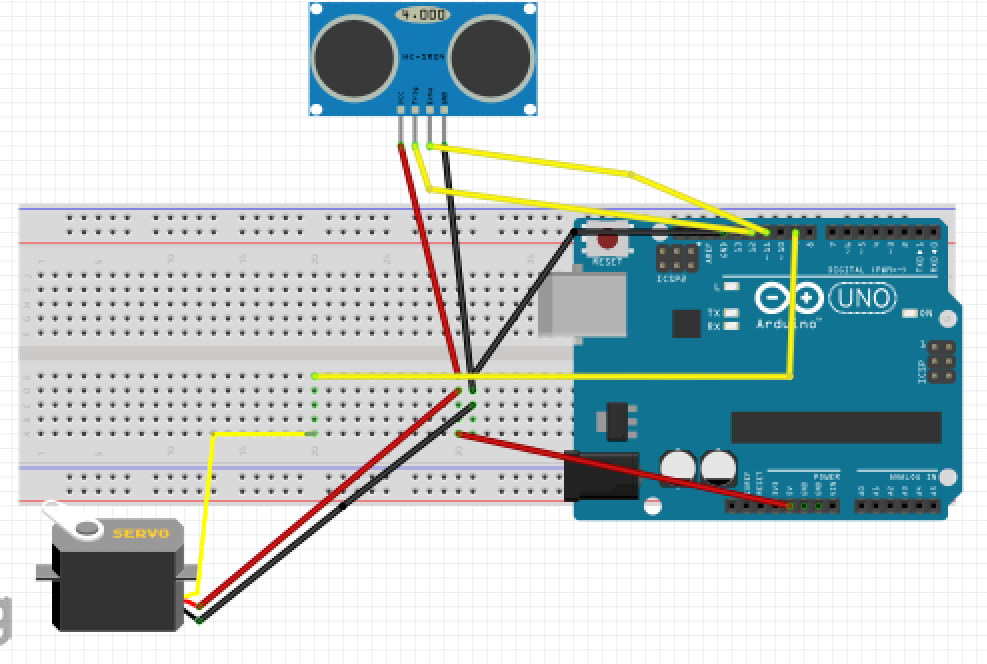
Productieproces
- TinyML Taaldetector met Edge Impulse op Arduino Nano 33 BLE Sense
- Bouw een real-time gyroscoop-spel met Arduino Nano & MPU-6050 sensor
- Arduino Digitale Dobbelsteen: Bouw Je Eigen LCD-willekeurige Getalgenerator
- Bouw een Ultrasonische Zweefapparaat met Arduino – Stap-voor-stap Handleiding
- Een slimme voltmeter bouwen met Arduino en smartphone – Eenvoudig DIY-project
- Arduino temperatuur- en vochtigheidslogger met DHT11 en Ethernet Shield
- Bouw een Slimme IoT Pot met ESP8266, Arduino & Ultrasonische Sensor – Real-time Monitoring
- Slimme Parkeer Teller: Real-time Voertuigvolging met Arduino, Processing en PHP
- Naadloze LED-dimmer met Bolt IoT en Arduino UNO
- Je TV bedienen met Alexa via Arduino IoT Cloud – stapsgewijze handleiding
- Bouw een Real-time Digitale Kompas met Arduino & Processing